EU Wealth Taxes: The Netherlands and Spain Show What’s Coming

Two EU countries have taken bold steps to tax savings and investments harder. Here’s the short version.

Netherlands – Tax on unrealized gains from 2028
From 1 January 2028, the Netherlands introduces the “Actual Return in Box 3 Act” (Wet werkelijk rendement box 3). 

  • It taxes actual returns on savings, shares, bonds, crypto and similar assets in Box 3. 
  • Both realised and unrealised gains are included — you pay even if you haven’t sold anything. 
  • Rate: 36%
  • Exemptions: property and startup shares (taxed only on sale). 
  • Small tax-free allowance: around €1,800 per year.

This followed Supreme Court rulings that the old fictional yield system was unlawful. Instead of scaling back, the government moved to a more aggressive model to protect revenue. Source

Spain – Permanent solidarity tax on large fortunes
Spain introduced a “temporary” solidarity tax on high net worth in 2022. It is now permanent. 

  • Applies to net wealth above €3 million (after a €700k deduction). 
  • Progressive rates: 1.7% (3–5M), 2.1% (5–10M), 3.5% (above 10M). 
  • National tax that overrides low-tax regions like Madrid. 
  • Regional wealth taxes still apply from lower thresholds in many areas.

Classic pattern: “temporary” becomes forever. Source

Both cases reveal the same pressure: ageing populations, high debt, and the need for revenue without raising ordinary income taxes further. The Netherlands goes furthest by taxing paper gains. Spain shows how quickly new levies stick.

For private savers the message is clear — governments are increasingly eyeing accumulated capital. Diversify, stay informed, and consider your options.


This is a new post on the new dewlar.me blog.
You can find the old blog here:https://mrsdewlar.blogspot.com
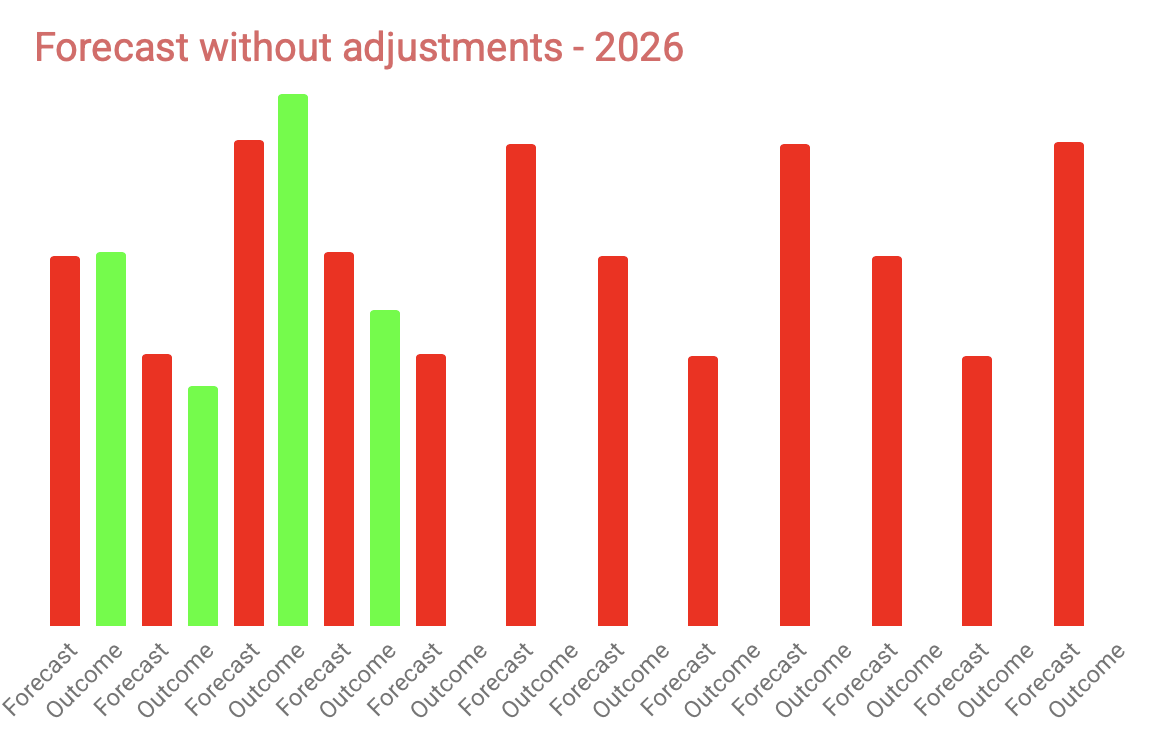

April Results: Better Than Expected, Worse Than My Pride Can Handle

After the final April dividend was registered, the result came in better than the adjusted forecast.

To track how our new strategy is playing out, I put together a new chart comparing the portfolio’s value development against the starting point on December 31, 2025.

So far the strategy looks successful — the portfolio is clearly up since the turn of the year. That’s ultimately what matters.

…But of course the hyper-competitive idiot in me can’t stop staring at the monthly deviations between forecast and actual outcome.

And that’s exactly where we’re getting absolutely schooled. Turns out selling off a bunch of solid dividend stocks in favor of growth stocks wasn’t the genius move I thought it was in January.

Game on.


This is a new post on the new dewlar.me blog.
You can find the old blog here:https://mrsdewlar.blogspot.com


PEP Gave Me a Raise – And Realty Income (O) Had a Good Day

Yesterday, one of my “employees” got a raise. PepsiCo, Inc. (PEP) increased its quarterly dividend by 4 % to $1.48 per share. Even though PEP is one of our smaller holdings, I’m genuinely grateful for the extra cash flow.

I was also pleased with Realty Income’s (O) quarterly report, which was released after market close. It showed solid growth, strong leasing activity and raised full-year guidance. In after-hours trading the stock saw a modest gain — nothing dramatic, but no disappointment either. Many analysts believe much of the good news was already priced in and that the market is now waiting for more details from the earnings call. 

Here’s hoping (O) can help offset some of the damage (TSLX) inflicted on the portfolio yesterday.


This is a new post on the new dewlar.me blog.
You can find the old blog here:https://mrsdewlar.blogspot.com


The Day I Thought Social Services Were Coming for Our Son

The world’s most perfect teenager turned 18 last September and overnight disappeared from all my banking apps, healthcare apps and just about everything else.

The only thing he hasn’t disappeared from is our insurance and the school app, which I still have access to until he graduates this summer. And honestly… I’m ridiculously grateful for that. I’m clearly not ready to stop being his mom in that way just yet.
He’ll always be my baby — no matter how tall he gets or how old he turns.

Eight years ago we got a letter from Social Services in Stockholm that made my stomach drop.

I tore it open in the dimly lit entrance hall by the mailboxes and tried to read it without my glasses. When that failed, I sprinted up the stairs to my husband.

The letter asked why our son wasn’t enrolled in school — even though school is compulsory in Sweden.

We had just switched him to the school he still attends today. We assumed the schools would handle the transfer and register him automatically when they applied for funding.

Turns out this school was completely private. And of course it was our job to notify the authorities.

For a few terrifying minutes I genuinely thought social services were coming to take our son.In the end, the only ones who had dropped the ball… were us.


This is a new post on the new dewlar.me blog.
You can find the old blog here:https://mrsdewlar.blogspot.com


Sharp Drop in Swedish Inflation – But Don’t Expect the Riksbank to Cut Rates

Statistics Sweden released the flash CPI figures today, and the numbers are surprisingly good.

The CPIF (which excludes mortgage rates) fell to just 0.8 % in April — half of the previous month’s level and well below the market’s expectation of 1.2 %.

The temporary VAT cut on food appears to have had a clear effect, helping to offset the impact of higher fuel prices caused by the Iran/US tensions.

Remember that CPIF already subtracts the effect of interest rates. The full CPI data will be released next week.

The Riksbank’s target is 2 % inflation with a tolerance band of ±1 %.

In a normal world, the Riksbank would be expected to cut the policy rate at tomorrow’s press conference. But with Erik Thedéen as governor — a well-known interest rate hawk — I expect the rate to remain unchanged.

This is exactly what I predicted last month.However, he might still refrain from his usual warning that “we may need to raise the policy rate further…” Link to my prediction from last month


This is a new post on the new dewlar.me blog.
You can find the old blog here:https://mrsdewlar.blogspot.com


My New Mini-App Already Proved Its Worth… And I’m Officially Dangerous Now

The little “app” I built has already come in handy.

I was hoping to close the books for April today, but we’re still missing one dividend: Rithm Capital Corp. (RITM).

This is the second month in a row I’ve had to call Nordea to chase down a missing dividend.

Last month it was The Kraft Heinz Company (KHC). I called them, they promised to look into it… and of course I never heard back. The dividend magically appeared the same day anyway.

Nordea doesn’t need to call me back. Just pay the money, thanks.

At this rate I’m seriously considering offering them my “expert help” building apps so they can see which dividends haven’t been settled.

Because nothing says “professional” like a 56-year-old who just learned to code two mini-apps and now thinks she can fix a major bank’s systems.

I’m officially dangerous.


This is a new post on the new dewlar.me blog.
You can find the old blog here:https://mrsdewlar.blogspot.com


Are they seriously going to screw us over again?

I started saving privately in IPS (Individual Pension Savings) already in 1998, the year it was introduced.

It was the Social Democratic government under Göran Persson that launched IPS on 1 January 1998 as a complement to the big pension reform. The idea was to encourage private saving with tax deductions because the new pension system would give a lower replacement rate than the old ATP.

Thirty-one years later, the rules have changed repeatedly. The tax deduction for IPS was eventually abolished on 1 January 2016 by Stefan Löfven’s government together with the Greens.

In 2012, the Alliance government introduced ISK (InvesteringsSparKonto) – a much simpler way to save in shares and funds with a flat-rate tax instead of reporting every single transaction. It was a win-win for both savers and the state.

Since then, the conditions for ISK have been adjusted several times – sometimes improved, sometimes worsened. Now the opposition (Social Democrats, Left Party and Greens) has once again promised to make it less attractive if they win the election this autumn: lower tax-free thresholds, higher standard tax on larger balances, etc.

It feels like every time ordinary Swedes manage to save and build something for the future, the Left immediately starts looking for ways to tax it more heavily or make it less worthwhile.

As if they don’t actually want ordinary people to become financially secure — or, God forbid, financially independent.


This is a new post on the new dewlar.me blog.
You can find the old blog here:https://mrsdewlar.blogspot.com


I Started Saving for My Pension Before I Turned 25 – And Now I’m Wondering If It Even Matters

I’m grateful I understood early on that the state pension would never come close to replacing my salary, no matter how long I worked. That’s why I started saving privately even before I turned 25.

Thirty-one years later, a lot has changed — both in the Swedish pension system and in society at large. Now a new threat is appearing on the horizon: the sharp decline in childbearing.

Sweden has gone from being one of the EU’s top countries for newborns to landing firmly in the middle, with roughly 1.4 children per woman. Fewer children today means fewer future workers and taxpayers tomorrow. Schools and businesses will feel it. The economy will feel it. And eventually, so will our pensions.

If nothing changes, the state pension could be significantly lower than today’s projections.

When I retire in 11 years, I will have worked and paid into the system for a total of 42 years.

I’m starting to wonder if I’ll be happy just to get anything at all from the state pension.

Or maybe I should just be grateful that my paranoid 24-year-old self had better foresight than the Swedish pension system ever will.


This is a new post on the new dewlar.me blog.
You can find the old blog here:https://mrsdewlar.blogspot.com


When Does Something Good Suddenly Become Bad?

Last night during the party leaders’ debate, Magdalena Andersson (Social Democrats) said that not many teachers have 3 million SEK in their ISK accounts. Nicklas Andersson from Montrose gave a clear and mathematically correct answer: it’s not about the snapshot — it’s about direction and time.

A regular Swede who saves a reasonable portion of their after-tax salary every month can very well end up with one or several million SEK in their ISK after 10–15 years. It’s not about being rich from the start. It’s about consistent saving over time.

The exact same logic applies to companies.

Every large company once started with an ordinary person who had an idea and a regular job. No one thought that was wrong. On the contrary — it was often celebrated.

But somewhere along the way, when the company grew and became successful, the attitude changed. Suddenly the same person was no longer a hardworking entrepreneur, but a “capitalist” who the Left believes should be heavily taxed and viewed with suspicion.

So when exactly does the turning point occur?

When does the ordinary saver or entrepreneur stop being “one of us” and become “one of them”?
Is it when they reach one million in their ISK?
When the company has ten employees?
When they hit a certain profit margin?

Or is it simply the moment they succeed?

It’s an interesting question. Because it doesn’t seem to be about how they got there — but about the fact that they got there at all.

This reflection was sparked by Nicklas Andersson’s excellent post on X


This is a new post on the new dewlar.me blog.
You can find the old blog here:https://mrsdewlar.blogspot.com


PepsiCo Once Owned a Navy – For About Five Minutes

In 1989 Pepsi struck one of the weirdest deals in history.

The Soviet Union couldn’t pay in cash, so they paid with military hardware: 17 submarines, a cruiser, a frigate and a destroyer. For a brief, glorious moment, PepsiCo technically owned the world’s sixth-largest navy.

The ships were rusty, decommissioned and headed straight for scrap. Pepsi never sailed them — they just took a 25 % cut of the scrap value and moved on.

Looking at the world today with all its conflicts… I’m not sure those vessels would have been scrapped so quickly. In fact, as a PepsiCo shareholder I might even have been a little disappointed when they did.

Just think about it: a private navy you could rent out to the highest bidder in today’s endless wars?

That’s not just profitable — that’s next-level diversification.

Sometimes a good investment sound completely insane on paper.


This is a new post on the new dewlar.me blog.
You can find the old blog here:https://mrsdewlar.blogspot.com